Witch Gupta Traditions Continue to Influence the Art of India Today


By Dr. Arathi Menon
Historian of Art and Architecture
Introduction
During the Gupta menstruation (c. 320 – 647 C.E., named for the Gupta dynasty) in that location were tremendous advances in verse, prose, and drama as well as of import discoveries in mathematics and astronomy. This was the historic period of some of the nigh celebrated creatives in Indian history, including the 5th century writer Kālidāsa whose works would influence generations of writers. This was also the period in which the fifth century astronomer Aryabhata theorized that the earth rotated on its own axis and calculated the solar year at 365.3586805 days.
The Puranas, a compendium of religious literature considered sacred to both the Hindu and Jain religious traditions and consisting of stories and the genealogies of the gods, folk tales, and traditional lore, grew in prominence during the Gupta years. While it is hard to date the Puranas because they contain anonymous texts compiled over many centuries both before and later on the Gupta flow, we know that Puranic stories were a popular religious and cultural reference during the Gupta years from the depiction of Puranic episodes in art and architecture. Kālidāsa's poetry and plays as well frequently engaged with episodes from the Puranas.
The Guptas were ambitious rulers and past the stop of the 4th century claimed dominance over a vast swathe of northern India (see map above). They maintained a capital at Pataliputra, the same ancient heart used by the formidable, and earlier, Mauryan empire (fourth – 2d century B.C.Due east.) and that of the emperor Ashoka Maurya (3rd century B.C.E.).
The gold money above shows Chandragupta Ii — i of the earliest and about successful Gupta rulers — who reigned from c. 380 C.Due east. to 415 C.E. Chandragupta is regally dressed, as is his horse, and he holds a bow equally his sash flies behind him. This type of iconography emphasizes the emperor'southward identification as a conqueror and the inclusion of a goddess (on the contrary side of this coin, not shown) implies divinely mandated rule. Fa Hsien, a Buddhist pilgrim from China, who was in Bharat during the reign of this king wrote with admiration about the prosperity of the empire, describing it as a charitable place with hospitals, rest-houses, and medicine for those in need.
The Golden Age of Indian Culture?
Although Gupta overlordship was significant throughout the empire in the early years and later, local rulers were allowed a off-white bit of autonomy in their territories. It is important therefore to not conflate the innovations and achievements of the Gupta period with the Guptas, and to admit the contributions of regional dynasties. This is specially important when works of art and architecture dated to the Gupta period are missing contextual data. Rather than assigning the Gupta dynastic label to these works of art and architecture, art historians utilize methods of connoisseurship to understand the artists, patrons, and provenance of these works. In the procedure, we are able to ameliorate sympathize the artistic developments of the period as a whole.
The Gupta period was termed the "Golden Age of Indian Culture" by some early observers who assigned the vast quantity and sophisticated quality of art from that period to the sponsorship of the Guptas. The term "Golden Age" was based on the want of these writers for an ideal or classical manner of art (using the art of ancient Greece every bit an example), and the opinion that art after the Gupta period was less classical and besides decadent to exist tasteful. The artistic developments of regional kingdoms in the Gupta era problematizes this Eurocentric perspective. The fifth and 6th century rock-cut temples at Ajanta and Elephanta, in the domain of the Vakataka and Kalachuri rulers respectively, are prominent sites that point to a richer and more circuitous fine art history of the Gupta period.
That is not to say that the Gupta rulers themselves were not of import patrons of art and architecture. The Udaigiri complex of stone-cutting caves in Madhya Pradesh (a large state in central India) is a an exceptional site with inscriptions that bespeak sponsorship from the Gupta court. Nineteen of the site'southward twenty caves are dedicated to Hindu gods and appointment to the quaternary and fifth centuries; one cavern is defended to the Jain religion and is dated to the early fifth century.
Varaha, the Human-Boar Avatar
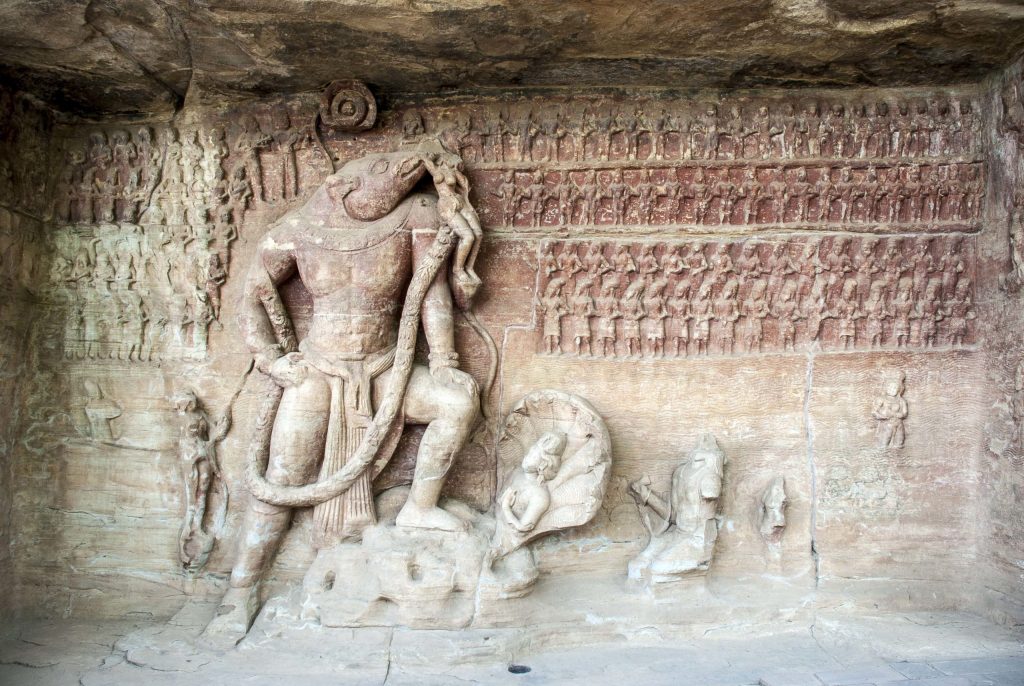
A sculptural panel at Udaigiri (in cave number 5) depicts the Hindu god Vishnu in his human-boar course avatar known as Varaha. The panel shows Varaha rescuing Bhudevi (goddess of earth) from a cosmic flood, a story that is recounted frequently in Hindu religious literature, including the Puranas. Varaha is shown here as a hero posing regally with the goddess as she dangles from his tusk. An audience of gods, sages, and people — almost in crowds of organized rows — witness the upshot with awe.
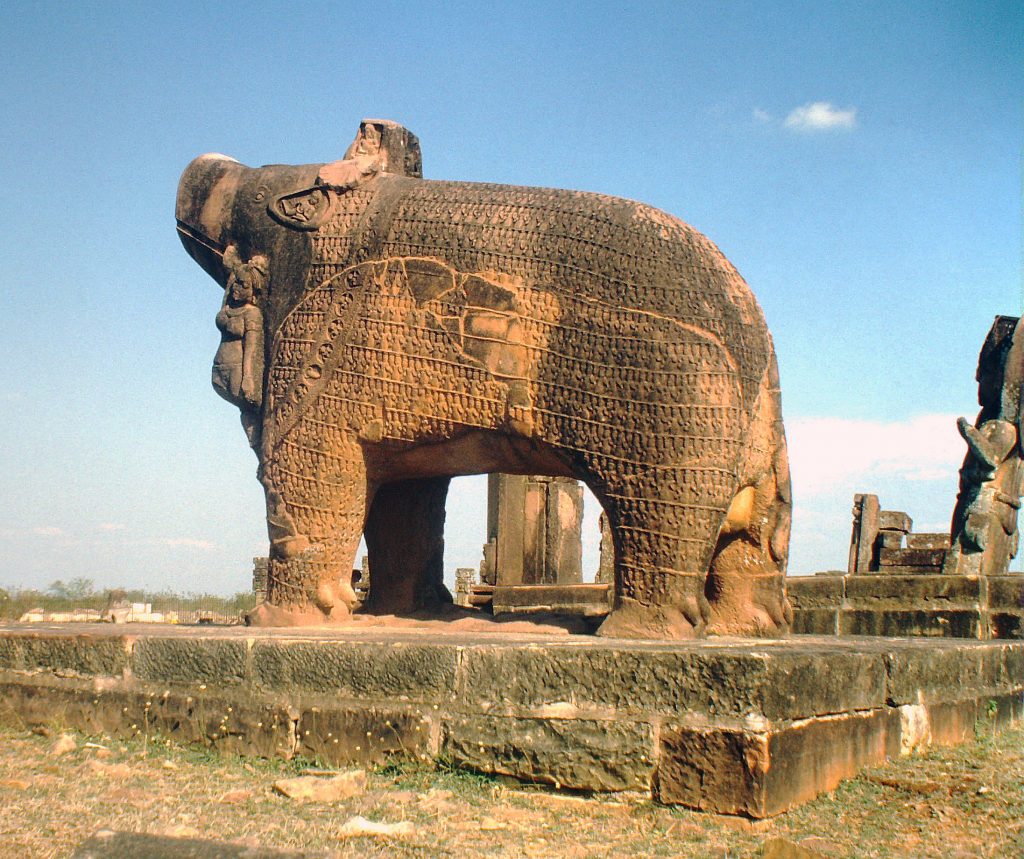
Scholars take suggested that the Guptas may have been particularly attached to the Varaha avatar of Vishnu. A remarkable sculpture — this time showing the Varaha avatar in the form of a boar (not a man-boar as at Udaigiri cavern number 5) — is plant in Eran, another site in Madhya Pradesh. Eran has a number of temples dated to the Gupta menstruation and its association with the Guptas is well-established by fashion of inscriptions.
Eran's Varaha is colossal – nearly twelve feet in height – and is shown over again with the goddess holding on to his tusk. The artists cleverly included the witnesses of the miracle on Varaha's body itself which is covered almost entirely by rows of spectators. Boosted figures are also carved on his ears and snout.
The Gupta Buddha
The aniconic tradition of representing the Buddha was abased by this phase in favor of depictions of the deified Buddha and the Gupta menstruum boasts some of the most impressive examples. Scholars accept suggested that the style of the Gupta Buddha evolved out of the Gandhara and Mathura style of Buddhas. The Gandhara and Mathura Buddhas were distinct versions of the Buddha image developed during the Kushan empire (2nd century B.C.E. – 3rd century C.E.) in the Gandhara and Mathura regions respectively. Kushan-ruled territories became part of the Gupta empire and it is certainly possible that the aesthetic fashion of Buddha images produced in those areas inspired the evolution of the Gupta Buddha.
The procedure past which the amalgamation of features from both the Gandhara and Mathura styles led to the Gupta image was surely a complex and involved process that adult over centuries. In addition, while Gupta period artists appear to accept inherited the developments of the Kushan empire in many aspects, they likely also gained from the developments of fine art produced in other regions and kingdoms — both previous and contemporaneous. It is helpful to also remember that artists and therefore styles of art may have been itinerant at various points in history.
Gupta flow Buddhas are characterized by covered shoulders, a head full of tight curls that cover even the ushnisha, and ornately carved halos. Images of the Jina (the 24 great teachers and perfected beings of the Jain religion) from this period are closely similar to Buddha images, especially in the rendering of a caput of tight curls. The Jina's posture and adornment follows the iconographic prescriptions of Jain sacred imagery and emphasize immobility and austerity.
"Gupta" equally a Style
While using the Gupta dynastic label to categorize all art produced in the Gupta period is, as we take seen above, problematic, at that place are certain developments in style and iconography from the Gupta period that are important to note, such equally the tendency to render deities as life-sized or larger and the consistent use of hierarchic scaling. Encounter the Varaha panel at Udaigiri to a higher place, for case.
Workshops in the Gupta period also employed signature styles. Images of the Buddha from the Mathura region, for instance, were produced in mottled red sandstone. The Mathura workshops too preferred to render the folds of the Buddha's robes every bit looped strings equally opposed to the thick folds preferred past Gandharan workshops in the Kushan menstruum. Buddha images from the region of Sarnath, on the other hand, were made from a yellowish-tan sandstone and are shown wearing shine robes.
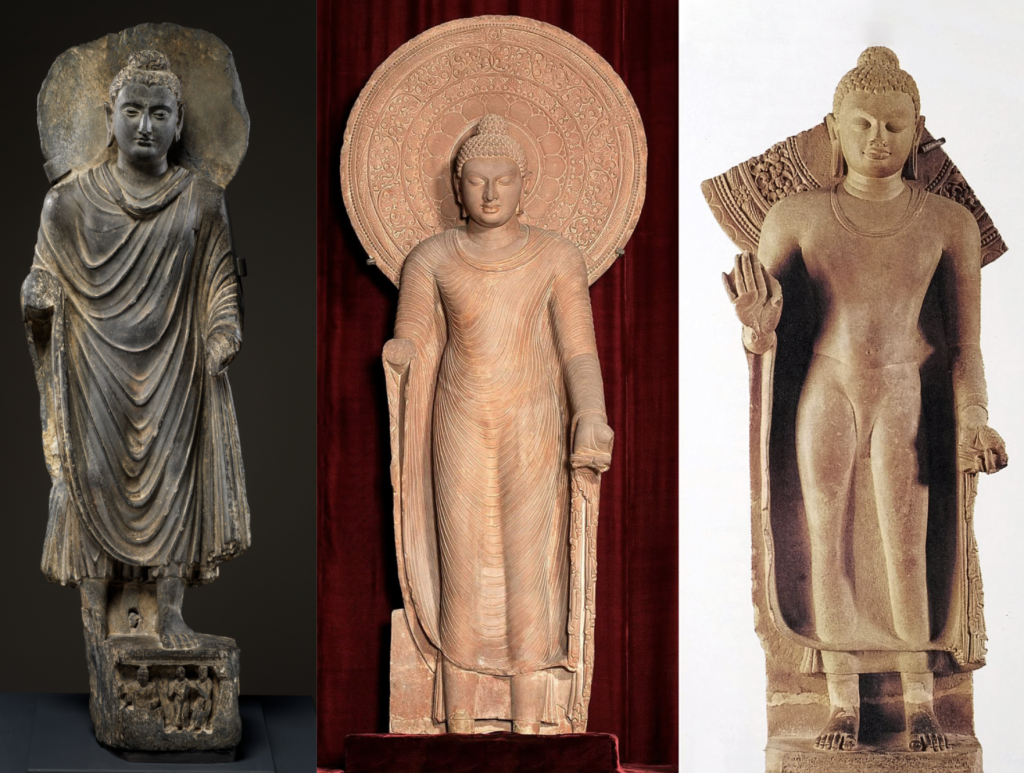
Scholars believe that portable Gupta period Buddhas, carried by pilgrims dorsum to their homelands, played a role in the development of the Buddha image in the fine art of Eastward and Southeast Asia. The Gupta Buddha would also influence afterwards images of the Buddha in South asia — such equally those that were produced in the territory of the Pala dynasty (c. 700 – 1200) in eastern Bharat. The Pala period saw the Buddha image develop even further and is notable for its inclusion of ornate crowns.
Gupta Period Sculpture and Painting
In add-on to its prolific production of Buddha images, the Gupta period is also known for its Hindu and Jain sacred imagery fashioned from terra cotta, stone, and metal. Surviving terracotta examples include sculptural plaques that were meant to adorn the walls of temples.
The terracotta console above shows the Hindu god Krishna (besides an avatar of Vishnu) killing the horse demon Keshi. Krishna pushes the horse-demon dorsum with his leg and sticks his elbow in Keshi's rima oris to stop the demon's advance. If there is any doubt every bit to the aftermath of this run across, the dead Keshi lies at the bottom of the console.
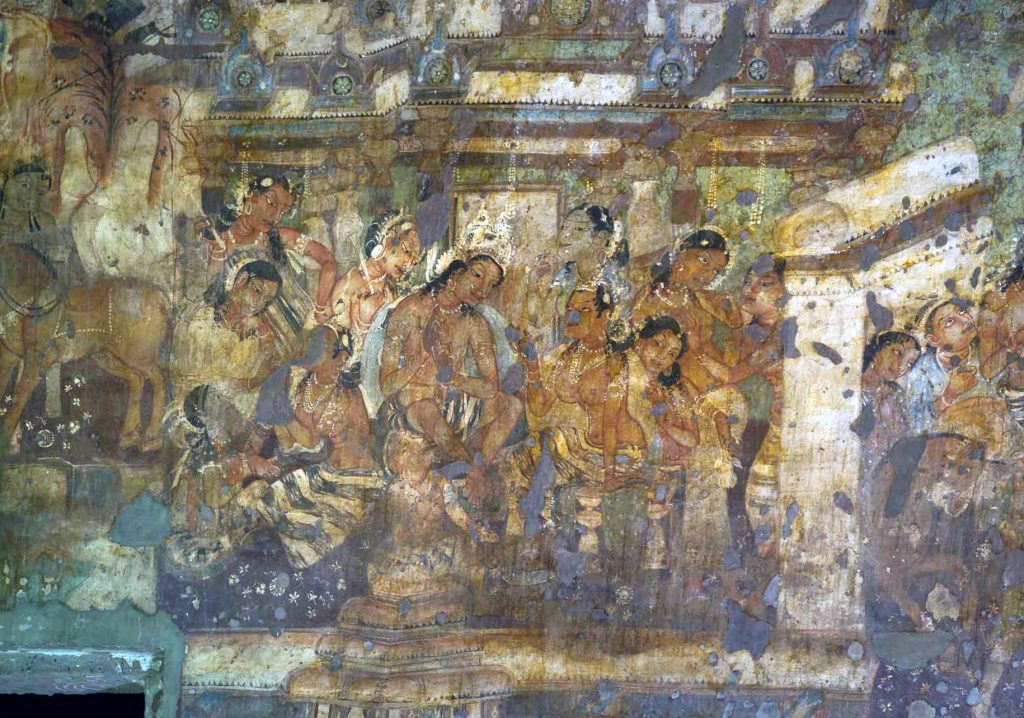
Painting as well was likely a popular art-form in the Gupta period, although sadly, few examples have survived. If the mural paintings at the Buddhist rock-cut caves of Ajanta are any indication, painting techniques past the fifth century were highly developed. Ajanta's paintings are also priceless for the clues that they comprise on the artistic achievements of the period; nosotros only need look at the accessories and apparel worn past the protagonists of the murals as well equally at the architectural spaces that they occupy to amend know the mode of jewelry, textiles, and secular compages that was popular at that time.
Temple Architecture
Nigh Gupta-flow architecture that survives in-situ is religious in nature and is congenital from rock and brick. A modest temple structure known as number 17 at the sacred complex at Sanchi – famous for its great stupa, and believed to date to the early fifth century, gives an idea of the early on style of Indian temple architecture.
Temple number 17 is flat-roofed, mostly unadorned, and has an fastened portico marked by four pillars topped with king of beasts capitals. The temple is quite different from some other fifth century brick-temple at Bhitargaon that sits at the eye of a square plan and would have once had an impressive shikara (pyramidal roof). Although the temple is heavily reconstructed today, it all the same preserves some of its sculptured terracotta panels, providing a glimpse of its original grandeur.
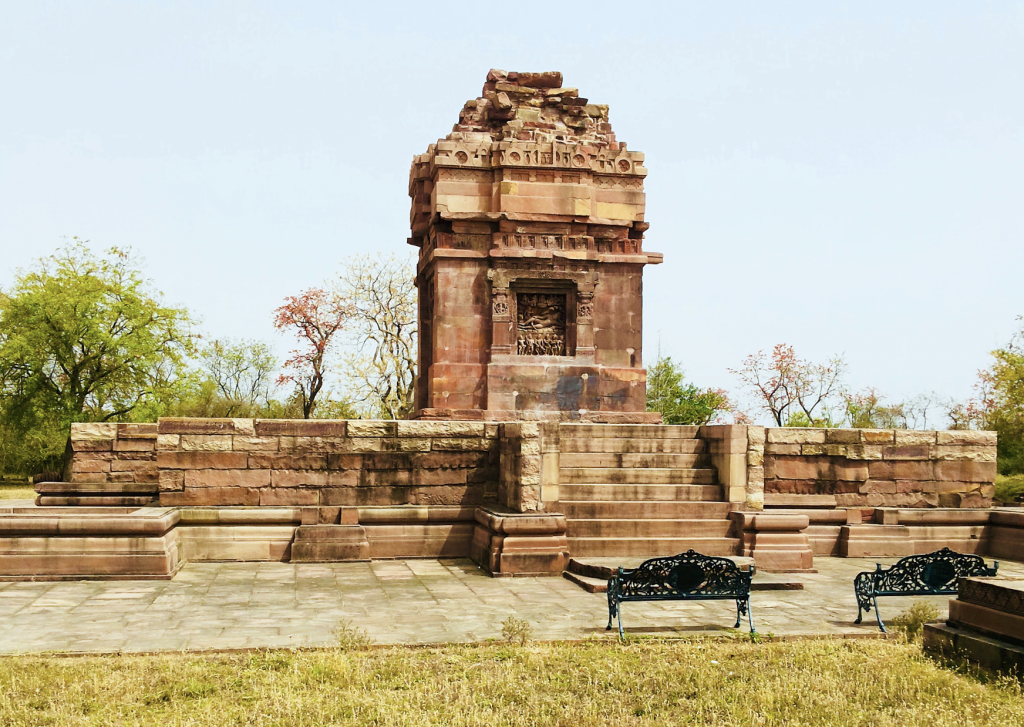
Another Gupta menstruation temple, the sixth century Dasavatara temple at Deogarh (above), besides sits at the center of a plinth (an architectural feature that becomes increasingly common in temple building). Like Bhitargaon, Deogarh features sculptured panels, although here, iii big niches containing sacred imagery associated with the god Vishnu receive special prominence — each one featured on its ain wall. The panels may have originally been located within an ambulatory that is at present missing.
By the end of the 6th-century, hastened by military incursions and the loss of territories, the Gupta empire fell into decline. Yet, the Gupta period'due south formative developments in art, compages, and religious iconography would have a lasting affect on the art and architecture of Southward and Southeast Asia.
References
- Frederick Asher, "Historical and Political Allegory in Gupta Art." In Essays on Gupta Civilisation, ed. Bardwell Smith (Delhi: Motilal Banarsidass, 1983), pp. 55 – 57.
- Catherine Becker, "Not your average boar: the colossal varaha at Eran, an iconographic innovation," Artibus Asiaelxx, no. 1, "To My Mind": Studies in South Asian Art History in Award of Joanna Gottfried Williams. Part 2 (2010): 123 – 149.
- Vidya Dehejia,Indian Art(London: Phaidon Press, 1997).
- Wendy Doniger,The Hindus: an Alternative History(Oxford: Oxford University Press, 2010).
- Partha Mitter,Indian Art(Oxford: Oxford Academy Printing, 2001).
- Ju-Hyung Rhi, "From Bodhisattva to Buddha: the Starting time of Iconic Representation in Buddhist Art,"Artibus Asiae54, no. 3 / 4 (1994): 207 – 225.
- Bardwell 50. Smith,Essays on Gupta Culture(Columbia: Due south Asia Books, 1983).
Originally published past Smarthistory, 03.26.2020, under a Creative Commons Attribution-NonCommercial-ShareAlike 4.0 International license.
Comments
Source: https://brewminate.com/art-and-architecture-in-early-medieval-indias-gupta-period/
0 Response to "Witch Gupta Traditions Continue to Influence the Art of India Today"
Post a Comment