Youll Never Pee Again She Said
Introduction 
Millions of people in the Usa struggle with Overactive Bladder (OAB) symptoms. The most common symptom is the ongoing urgent demand to get to the bathroom. Now.
OAB can interfere with piece of work, going out with friends, exercise and sleep. It tin lead you to the bathroom many times during the day or night. Some people leak urine (pee) after this urgent "gotta go" feeling. Others feel afraid they'll leak.
Fortunately, there is help and in that location are treatments.
What is OAB and Who Gets Information technology?
Overactive bladder is the name for a group of float symptoms. There are three main symptoms:
- A feeling that you lot accept to go to the bathroom, urgently.
- Sometimes incontinence, which ways that you leak urine with the "gotta go" feeling.
- Usually the need to go to the bath often (frequently), day and dark.
With OAB, y'all feel that yous need to empty your bladder – fifty-fifty when it's not full. This leads to the feeling that you need a bathroom quickly, correct now. You tin can't control or ignore this feeling. (Although it may experience similar your bladder muscle is squeezing to empty your bladder, in actual fact your bladder muscle may not be squeezing.) If you lot "gotta go" viii or more times each mean solar day and dark, or fear that urine volition leak out before you lot're ready, you may have OAB.
OAB affects about 33 1000000 Americans. Information technology'south not a normal part of aging. It's a wellness problem that tin can final for a long fourth dimension if it's not treated. Many older men (30%) and women (40%) struggle with OAB symptoms. Frequently people don't know nearly treatments that can aid, or they don't enquire for help.
Stress urinary incontinence or SUI is a unlike bladder problem. People with SUI leak urine while sneezing, laughing or being active. It is not the aforementioned every bit that sudden "gotta go" feeling from OAB. To learn more about SUI, go to https://www.urologymanagement.org/sui/.
In this guide y'all will find clear information about how to manage OAB. Delight inquire for aid, fifty-fifty if you experience embarrassed. Don't look, because there are several treatments that work well for OAB. Your health intendance provider should exist trained to talk with you and aid you manage your symptoms without embarrassment.
For data well-nigh the other wellness care providers trained to help, click here.
How the Urinary Tract Works and What Happens with OAB
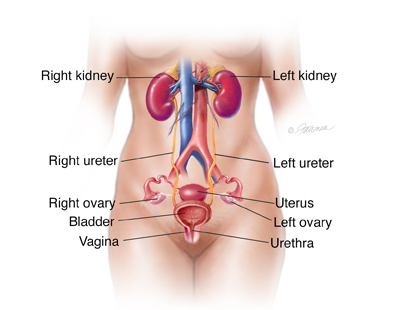
Urinary tract
Medical Illustration Copyright © 2022 Nucleus Medical Media, All rights reserved
The urinary tract is the important system that removes liquid waste from our bodies:
- kidneys: 2 bean-shaped organs that clean waste material from the blood and brand urine
- ureters: 2 thin tubes that take urine from the kidney to the bladder
- bladder: a balloon-like sac that holds urine until it's time to go to the bathroom
- urethra: the tube that carries urine from the bladder out of the body. The urethra has muscles called sphincters that lock in urine. The sphincters open to release urine when the bladder contracts.
When your bladder is full, your brain signals the bladder. The bladder muscles and then squeeze. This forces the urine out through the urethra. The sphincters in the urethra open and urine flows out. When your bladder is not full, the bladder is relaxed.
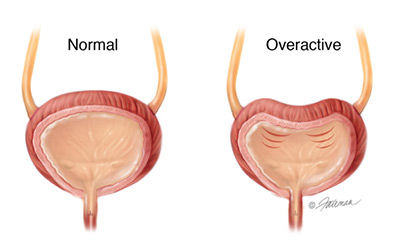
Float and sphincter
Image © 2003 Fairman Studios, LLC
With a healthy bladder, signals in your encephalon let you know that your bladder is getting total or is full, merely y'all tin expect to become to the bathroom. With OAB, you can't wait. Yous experience a sudden, urgent demand to go. This can happen fifty-fifty if your bladder isn't full.
Symptoms of OAB
Urgency: This is the main symptom of OAB. It is a potent (urgent) need to urinate that can't exist ignored. This "gotta go" feeling makes people afraid that they'll leak urine if they don't find a bathroom correct away. OAB may too crusade:
- Incontinence (urine leaks): Sometimes OAB causes urine to leak out before getting to the bathroom. This is called "urgency incontinence." Some people may leak just a few drops, while others can take a sudden gush. (for more information: https://world wide web.urologyhealth.org/urologic-conditions/urinary-incontinence)
- Urinate frequently: OAB may as well cause people to go to the bathroom many times during the solar day. Experts say that "frequent urination" is when you accept to go to the bathroom more than than 8 (8) times in 24 hours.
- Wake up at nighttime to urinate: OAB tin wake a person from sleep to become to the bathroom more than in one case a dark. This is called "nocturia" by health providers.
Some foods and drinks can bother the bladder. Caffeine, artificial sweeteners, alcohol, chocolate and very spicy foods may make OAB symptoms worse.
OAB does not cause pain. If you feel pain while urinating, you may take an infection. Please talk with your health care provider about pain.
How OAB Tin can Touch Your Life
Without treatment, OAB symptoms are uncomfortable. Information technology tin be hard to go through the 24-hour interval without many visits to the bathroom. OAB tin affect relationships. You may not want to do things you savor because you worry about finding a bathroom in time. It can disrupt your sleep and sex life. It can exit you tired and short-tempered, or leaks tin lead to a rash or infections. The whole experience can make anyone feel hopeless and very unhappy.
The good news is that OAB can exist controlled. In that location are treatments bachelor to help.
Finding the Words
It's normal to feel uncomfortable when talking about OAB symptoms. Who wants to talk near bathroom issues or incontinence?! Still, knowing more than about OAB is the best way to take control of the trouble. A trivial planning volition give you confidence. Here are some tips to help:
- Exist prepared: Earlier your date, assemble useful data to assist the wellness intendance provider learn what'south going on. Also be set up to take notes about what you learn. Bring:
- A list of the prescription drugs, over-the-counter medicines, vitamins and/or herbs you take.
- A list of your past and current illnesses or injuries.
- Results from the Think You Accept Overactive Float? Quiz , to help you discuss your symptoms.
- A pad of paper and pen to accept notes about treatments
- Bring a friend: Ask a close friend or relative to go with you lot to the doctor, if you don't mind sharing what's going on. An "appointment buddy" can help remind y'all of things you may forget to inquire, or remind y'all of things the health care provider said.
- Bring upwards the topic: If your health care provider doesn't inquire nearly your OAB symptoms, bring upwards the topic yourself. Don't look until the end of your visit. Make certain you lot accept fourth dimension for questions. If a nurse meets with you first, tell the nurse nigh your symptoms.
- Speak freely: Share everything you lot're experiencing. Your health care provider hears almost problems every day. They've heard it all! Information technology's OK to tell them virtually your symptoms and how they impact your daily life. Let your health care provider know your answers to these questions:
- Practice my symptoms brand me end doing the things I enjoy, or prevent me from going to events?
- Am I afraid to exist also far away from a bathroom?
- Accept my symptoms changed my relationships with friends or family unit?
- Do my symptoms make it hard to get a skillful night's sleep?
- Ask questions: A visit to your health care provider is the right fourth dimension to ask questions. It is all-time to bring your list of questions with you so you don't forget. We offer some good question to enquire in each section of this guide to assist y'all.
- Follow-up intendance: Ask your health care provider when yous should visit once more, and what you should bring with you.
How to Diagnose OAB
When you tell your health care provider nigh your symptoms, south/he will ask more questions and do some tests. This is done to diagnose the problem. OR, your provider will tell yous the proper noun of a specialist who tin diagnose and care for yous.
To learn what'due south happening, a health care provider will likely:
- Inquire most your health history: Yous volition be asked about how you feel, how long you lot've had symptoms, and how they impact you. You will be asked about medicine you accept (over-the-counter and prescribed). You lot should also talk virtually what you eat and drink during the twenty-four hours. This lets your provider learn about your health at present and in the past.
- Do a physical test: Your health care provider volition look for things that could cause symptoms. In men and women, they will feel your organs in and below your belly, in your pelvic expanse. They will likewise check your rectum.
- Ask you to continue a "Bladder Diary:" A Bladder Diary helps you, and your doctor, learn well-nigh daily events and patterns. In this diary you write downward how oft you go to the bathroom and if/when you leak urine. You can use this Float Diary sample to get-go. You tin too download an electronic bladder diary for your mobile device similar The Bladder Pal. This app was developed by AUA Member, Dr. Ronald Yap, through the support of the LeBaron Foundation and the Concur Hospital Trust.
- Bladder Pal app for Android
- Bladder Pal app for Apple tree
- Exercise other tests if you lot need them:
- Urine test: a sample of your urine may be tested for infection or blood.
- Bladder browse: This test shows how much urine is left in your bladder after you go to the bathroom.
- Cystoscopy: Your wellness care provider inserts a thin tube with a tiny camera into the bladder to see if it looks normal or not.
- Urodynamic testing: These tests check to see how well your lower urinary tract holds and lets-go of urine. One of these tests is call CMG (cystometrogram ).
- Symptom quiz: Many doctors apply a written quiz to ask questions about your bladder problems and what causes you the most bother. Have our OAB Quiz
There are a number of things you lot tin can do to help manage OAB. Everyone has a different experience with what works best. You may try one treatment solitary, or several at the same time. You and your health care provider should talk about what you want from treatment and about each option.
OAB treatments include:
Lifestyle Changes
To manage OAB, health intendance providers showtime ask a patient to make "lifestyle changes". Sometimes these changes are called "behavioral therapy". This could hateful that y'all eat different foods, change how much, when or what you potable, and pre-plan bath visits to feel better. Many people find that these changes help. Other people need to do more.
- Limit food and drinks that bother your bladder: Many people feel better when they change the manner they eat and drink. At that place are certain foods known to bother the bladder. You can endeavor taking all of these things out of your diet, then add them back one at a time. One time y'all learn which foods and drinks make your symptoms worse, you tin can avoid them. Common foods to avoid:
- Coffee / caffeine
- Tea
- Artificial sweeteners
- Alcohol
- Soda and other fizzy drinks
- Citrus fruit
- Food made with tomatoes
- Chocolate (not white chocolate)
- Spicy foods
- Keep a bladder diary: Writing down when you make trips to the bathroom for a few days tin can help you understand your body meliorate. This diary may testify you things that make symptoms worse. For case, are your symptoms worse later on eating or drinking a sure kind of nutrient? Are they worse when you don't drinkable enough liquids?
- Double voiding (elimination your bladder twice): This may exist helpful for people who have problem fully emptying their bladders. After you go to the bathroom, yous wait a few seconds and then try to go over again.
- Delayed voiding: This means that you practice waiting before you go to the bathroom, even when you take to go. At offset, you wait merely a few minutes. Gradually you may exist able to wait 2 to 3 hours at a time. Only try this if your health care provider tells you to. Some people feel worse or have urine leaks when they wait too long to go to the bath.
- Timed urination: This means that you follow a daily bath schedule. Instead of going when yous feel the urge, you become at prepare times during the twenty-four hour period. You lot and your health care provider will create a reasonable schedule. You may try to urinate every two to 4 hours, whether you feel you lot have to get or not. The goal is to preclude that "urgent" feeling and to gain control.
- Exercises to relax your bladder musculus: You may be familiar with exercises to strengthen your pelvic floor muscles, also chosen Kegel exercises. A special do using those same pelvic floor muscles may help relax your bladder during those "gotta go" moments. To practise "quick flicks," you lot quickly squeeze and relax your pelvic floor muscles repeatedly. When y'all feel the urge to go, try a number of "quick flicks" instead. These exercises tin can assist command that "gotta become" feeling. Information technology helps to be still, relax and focus on just the exercise. Your health care provider or a concrete therapist can help you learn these exercises. Biofeedback may also help. Biofeedback uses computer graphs and sounds to monitor muscle movement. Information technology can assistance teach y'all how your pelvic muscles move and how strong they are.
Prescription Drugs
When lifestyle changes aren't plenty, the next pace may be to take medicine. Your health intendance provider can tell you lot almost special drugs for OAB.
At that place are several types that can relax the bladder musculus. These drugs (for example: Anti-muscarenics and Beta-iii agonists) can help stop your bladder from squeezing when it's not full. Some are taken every bit pills, by mouth. Others are gels or a viscid patch to requite you the drug through your peel.
Your health intendance provider volition want to know if the medicine works for yous. They volition check to encounter if you get relief or if the drug causes issues, known equally "side-effects". Some people get dry mouth and dry out eyes, constipation, or blurred vision.
To assistance relieve symptoms, your health care provider may ask you to have dissimilar amounts of the drug. Or, give yous a dissimilar 1 to try. You may be asked to make lifestyle changes and take medicine at the same time for amend results.
Injections
If lifestyle changes and medicine aren't working, there are other options. A trained urologist or FPMRS specialist can help. They may offer float injections (shots) of Botox® (botulinum toxin).
Small amounts of Botox® tin can end the bladder muscles from squeezing too much. Many tiny injections are used. It gently paralyzes the muscles. Boosted treatments are given when this treatment wears off, anywhere from six to twelve months afterwards. Your doc will watch how you lot're doing to make sure you aren't retaining (belongings in) also much urine. If urine is not draining well, you may need to catheterize temporarily.
Nervus Stimulation (Neuromodulation Therapy)
Some other handling for people who need extra assistance is nervus stimulation, too chosen neuromodulation [pronounced: NER-oh-mahd-yoo-LAY-shun] therapy.
This blazon of treatment sends electrical pulses to nerves in your bladder. In OAB, the nerve signals betwixt your bladder and brain don't work the correct way. These electrical pulses interrupt the nerve signals, gear up them right, and improve OAB symptoms.
At that place are ii types:
- Sacral neuromodulation (SNS) changes how the sacral nerve works. This nerve carries signals between the spinal cord and the bladder. Its job is to assist concur and release urine. In OAB, these nerve signals aren't doing what they should. SNS uses a "bladder pacemaker" to command these signals to end OAB symptoms. SNS is a two-step surgical process. The commencement pace is to implant an electrical wire under the skin in your lower dorsum. This wire is first continued to a handheld "pacemaker" to send pulses to the sacral nervus. You lot and your doctor will test whether or non this pacemaker can help yous. If it helps, the second stride is to implant a permanent pacemaker that can regulate the nerve rhythm.
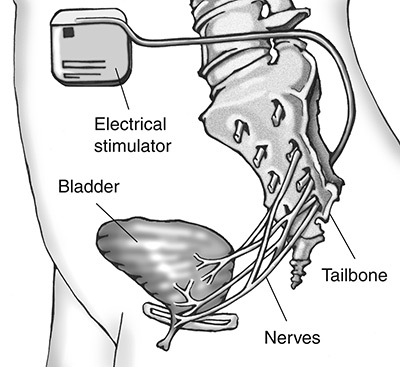
Sacral neuromodulation (SNS)
National Institute of Diabetes and Digestive and Kidney Diseases,
National Institutes of Health - Percutaneous tibial nervus stimulation (PTNS) is another way to correct the fretfulness in your bladder. For this type of nerve stimulation you lot will non accept to take surgery. PTNS is performed during an office visit that takes about xxx minutes. PTNS is done by placing a small-scale electrode in your lower leg nigh your ankle. It sends pulses to the tibial nerve. The tibial nerve runs along your human knee to the sacral fretfulness in your lower dorsum. The pulses help command the signals that aren't working right. Oft, patients receive 12 treatments, depending on how it's working. [This therapy is pronounced: PER-cyoo-TAY-nee-uhs TI-bee-ahl NERV STIM-yoo-LAY-shun.]
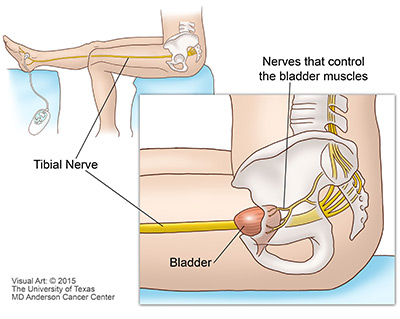
Percutaneous tibial nerve stimulation (PTNS)
(c)2012 The University of Texas K.D. Anderson Cancer
Other Resource
Here are a few more organizations that offering useful information to help people living with OAB and incontinence.
Urology Care Foundation
1-800-828-7866
The official foundation of the American Urological Clan, the Urology Intendance Foundation is committed to advancing urologic inquiry and education. We interact with researchers, health intendance providers, patients and caregivers to improve patients' lives.
American Urological Clan
The American Urological Association promotes the highest standards of urological clinical intendance through education, research and wellness care policy.
It's Time to Talk about OAB
Become the facts. Go diagnosed. Take command.
Order printed materials nearly OAB, take our "Overactive Bladder Quiz," and download a "Bladder Diary" to track your symptoms.
Information technology's Time to Talk nigh SUI
Find out more than about Stress Urinary Incontinence, order printed materials and have the SUI quiz.
National Kidney and Urologic Diseases Clearinghouse:
The National Kidney and Urologic Diseases Information Clearinghouse (NKUDIC) is a service of the National Establish of Diabetes and Digestive and Kidney Diseases (NIDDK) that provides data on kidney and urologic diseases. The NIDDK is function of the U.South. National Institutes of Health (NIH).
National Clan for Continence
The National Association for Continence is a national, private, not-profit organization defended to improving the quality of life of people with incontinence, voiding dysfunction, and related pelvic floor disorders. NAFC's purpose is to be the leading source for public education and advocacy about the causes, prevention, diagnosis, treatments, and management alternatives for incontinence.
Simon Foundation for Continence
The mission of the Simon Foundation is to bring the topic of incontinence out into the open, remove the stigma surrounding incontinence, and provide help and hope to people with incontinence, their families and the health professionals who provide their intendance.
Patient resource provided through the generous support of:

Source: https://www.urologyhealth.org/overactive-bladder
0 Response to "Youll Never Pee Again She Said"
Post a Comment