According to Jeanjacques Rousseau What Is the Top Pleasing Artin From Marriage?
Jean-Jacques Rousseau (1712—1778)
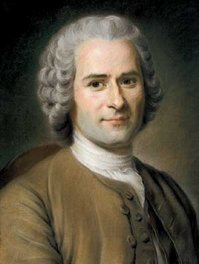 Jean-Jacques Rousseau was one of the most influential thinkers during the Enlightenment in eighteenth century Europe. His offset major philosophical work, A Soapbox on the Sciences and Arts, was the winning response to an essay contest conducted by the Academy of Dijon in 1750. In this work, Rousseau argues that the progression of the sciences and arts has caused the corruption of virtue and morality. This discourse won Rousseau fame and recognition, and it laid much of the philosophical groundwork for a second, longer work, The Discourse on the Origin of Inequality. The 2nd soapbox did not win the University'due south prize, but like the first, information technology was widely read and further solidified Rousseau's identify as a significant intellectual figure. The central merits of the work is that homo beings are basically good by nature, but were corrupted by the complex historical events that resulted in nowadays twenty-four hour period civil society.Rousseau's praise of nature is a theme that continues throughout his later works equally well, the nearly significant of which include his comprehensive work on the philosophy of pedagogy, the Emile, and his major piece of work on political philosophy, The Social Contract: both published in 1762. These works caused slap-up controversy in France and were immediately banned past Paris authorities. Rousseau fled French republic and settled in Switzerland, but he continued to find difficulties with authorities and quarrel with friends. The end of Rousseau's life was marked in big part by his growing paranoia and his connected attempts to justify his life and his work. This is peculiarly evident in his later on books, The Confessions, The Reveries of the Solitary Walker, and Rousseau: Guess of Jean-Jacques.
Rousseau profoundly influenced Immanuel Kant's piece of work on ethics. His novel Julie or the New Heloise impacted the tardily eighteenth century'south Romantic Naturalism movement, and his political ideals were championed by leaders of the French Revolution.
Table of Contents
- Life
- Traditional Biography
- The Confessions: Rousseau's Autobiography
- Groundwork
- The Beginnings of Modern Philosophy and the Enlightenment
- The State of Nature as a Foundation for Ideals and Political Philosophy
- The Discourses
- Discourse on the Sciences and Arts
- Discourse on the Origin of Inequality
- Discourse on Political Economy
- The Social Contract
- Background
- The Full general Will
- Equality, Liberty, and Sovereignty
- The Emile
- Background
- Education
- Women, Marriage, and Family
- The Profession of Organized religion of the Savoyard Vicar
- Other Works
- Julie or the New Heloise
- Reveries of the Solitary Walker
- Rousseau: Judge of Jean Jacques
- Historical and Philosophical Influence
- References and Farther Reading
- Works by Rousseau
- Works about Rousseau
one. Life
a. Traditional Biography
Jean-Jacques Rousseau was born to Isaac Rousseau and Suzanne Bernard in Geneva on June 28, 1712. His mother died only a few days later on July seven, and his just sibling, an older brother, ran away from home when Rousseau was all the same a child. Rousseau was therefore brought up mainly by his father, a clockmaker, with whom at an early age he read ancient Greek and Roman literature such as the Lives of Plutarch. His father got into a quarrel with a French captain, and at the gamble of imprisonment, left Geneva for the residual of his life. Rousseau stayed behind and was cared for past an uncle who sent him along with his cousin to study in the village of Bosey. In 1725, Rousseau was apprenticed to an engraver and began to learn the merchandise. Although he did non detest the work, he thought his main to be tearing and tyrannical. He therefore left Geneva in 1728, and fled to Annecy. Hither he met Louise de Warens, who was instrumental in his conversion to Catholicism, which forced him to forfeit his Genevan citizenship (in 1754 he would make a return to Geneva and publicly catechumen back to Calvanism). Rousseau's relationship to Mme. de Warens lasted for several years and somewhen became romantic. During this fourth dimension he earned money through secretarial, teaching, and musical jobs.
In 1742 Rousseau went to Paris to become a musician and composer. After two years spent serving a mail service at the French Diplomatic mission in Venice, he returned in 1745 and met a linen-maid named Therese Levasseur, who would become his lifelong companion (they somewhen married in 1768). They had v children together, all of whom were left at the Paris orphanage. It was also during this time that Rousseau became friendly with the philosophers Condillac and Diderot. He worked on several articles on music for Diderot and d'Alembert's Encyclopedie. In 1750 he published the Discourse on the Arts and Sciences, a response to the Academy of Dijon's essay contest on the question, "Has the restoration of the sciences and arts tended to purify morals?" This discourse is what originally made Rousseau famous every bit information technology won the University's prize. The work was widely read and was controversial. To some, Rousseau's condemnation of the arts and sciences in the First Soapbox made him an enemy of progress altogether, a view quite at odds with that of the Enlightenment project. Music was still a major office of Rousseau'south life at this point, and several years afterward, his opera, Le Devin du Village (The Hamlet Soothsayer) was a great success and earned him fifty-fifty more recognition. But Rousseau attempted to alive a minor life despite his fame, and after the success of his opera, he promptly gave up composing music.
In the fall of 1753, Rousseau submitted an entry to another essay contest announced past the University of Dijon. This time, the question posed was, "What is the origin of inequality amid men, and is information technology authorized by the natural police force?" Rousseau's response would become the Discourse on the Origin of Inequality Amongst Men. Rousseau himself thought this work to be superior to the First Soapbox considering the 2d Discourse was significantly longer and more than philosophically daring. The judges were irritated by its length too its bold and unorthodox philosophical claims; they never finished reading it. Yet, Rousseau had already arranged to accept it published elsewhere and like the Showtime Discourse, it besides was also widely read and discussed.
In 1756, a year afterward the publication of the Second Discourse, Rousseau and Therese Levasseur left Paris subsequently being invited to a firm in the country by Mme. D'Epinay, a friend to the philosophes. His stay here lasted merely a year and involved an affair with a woman named Sophie d'Houdetot, the mistress of his friend Saint-Lambert. In 1757, after repeated quarrels with Mme. D'Epinay and her other guests including Diderot, Rousseau moved to lodgings well-nigh the country dwelling house of the Duke of Luxemburg at Montmorency.
It was during this time that Rousseau wrote some of his about important works. In 1761 he published a novel, Julie or the New Heloise, which was one of the best selling of the century. And so, just a year later in 1762, he published ii major philosophical treatises: in April his definitive work on political philosophy, The Social Contract, and in May a book detailing his views on education, Emile. Paris authorities condemned both of these books, primarily for claims Rousseau made in them virtually religion, which forced him to abscond France. He settled in Switzerland and in 1764 he began writing his autobiography, his Confessions. A year subsequently, later encountering difficulties with Swiss regime, he spent fourth dimension in Berlin and Paris, and eventually moved to England at the invitation of David Hume. Nevertheless, due to quarrels with Hume, his stay in England lasted just a year, and in 1767 he returned to the southeast of France incognito.
After spending three years in the southeast, Rousseau returned to Paris in 1770 and copied music for a living. It was during this time that he wrote Rousseau: Judge of Jean-Jacques and the Reveries of the Solitary Walker, which would turn out to exist his final works. He died on July 3, 1778. His Confessions were published several years after his decease; and his later political writings, in the nineteenth century.
b. The Confessions: Rousseau'south Autobiography
Rousseau's own account of his life is given in corking detail in his Confessions, the same championship that Saint Augustine gave his autobiography over a thousand years earlier. Rousseau wrote the Confessions belatedly in his career, and information technology was not published until after his death. Incidentally, two of his other subsequently works, the "Reveries of the Solitary Walker" and "Rousseau Judge of Jean Jacques" are as well autobiographical. What is particularly hitting about the Confessions is the almost apologetic tone that Rousseau takes at certain points to explain the various public as well as private events in his life, many of which caused swell controversy. It is clear from this volume that Rousseau saw the Confessions as an opportunity to justify himself confronting what he perceived as unfair attacks on his character and misunderstandings of his philosophical idea.
His life was filled with conflict, first when he was apprenticed, afterward in bookish circles with other Enlightenment thinkers like Diderot and Voltaire, with Parisian and Swiss authorities and even with David Hume. Although Rousseau discusses these conflicts, and tries to explicate his perspective on them, information technology is not his exclusive goal to justify all of his actions. He chastises himself and takes responsibleness for many of these events, such as his extra-marital affairs. At other times, however, his paranoia is clearly axiomatic as he discusses his intense feuds with friends and contemporaries. And herein lays the fundamental tension in the Confessions. Rousseau is at the aforementioned time trying both to justify his deportment to the public so that he might gain its approval, merely as well to affirm his own uniqueness as a critic of that same public.
ii. Groundwork
a. The Ancestry of Modernistic Philosophy and the Enlightenment
Rousseau's major works span the mid to late eighteenth century. As such, it is appropriate to consider Rousseau, at to the lowest degree chronologically, as an Enlightenment thinker. Still, there is dispute as to whether Rousseau'southward idea is all-time characterized as "Enlightenment" or "counter-Enlightenment." The major goal of Enlightenment thinkers was to give a foundation to philosophy that was independent of whatsoever particular tradition, civilization, or religion: one that any rational person would accept. In the realm of science, this projection has its roots in the birth of modern philosophy, in large office with the seventeenth century philosopher, René Descartes. Descartes was very skeptical about the possibility of discovering final causes, or purposes, in nature. Yet this teleological understanding of the globe was the very cornerstone of Aristotelian metaphysics, which was the established philosophy of the time. And so Descartes' method was to doubt these ideas, which he claims can only be understood in a confused manner, in favor of ideas that he could excogitate clearly and distinctly. In the Meditations, Descartes claims that the material earth is made up of extension in space, and this extension is governed by mechanical laws that can be understood in terms of pure mathematics.
b. The State of Nature every bit a Foundation for Ethics and Political Philosophy
The scope of mod philosophy was not limited only to issues concerning scientific discipline and metaphysics. Philosophers of this period also attempted to employ the same type of reasoning to ethics and politics. I approach of these philosophers was to draw homo beings in the "land of nature." That is, they attempted to strip homo beings of all those attributes that they took to be the results of social conventions. In doing so, they hoped to uncover sure characteristics of human nature that were universal and unchanging. If this could be washed, one could then determine the most effective and legitimate forms of government.
The two most famous accounts of the state of nature prior to Rousseau's are those of Thomas Hobbes and John Locke. Hobbes contends that human beings are motivated purely by self-interest, and that the state of nature, which is the land of homo beings without civil gild, is the war of every person against every other. Hobbes does say that while the state of nature may not accept existed all over the world at 1 detail fourth dimension, it is the status in which humans would be if in that location were no sovereign. Locke'due south account of the country of nature is unlike in that it is an intellectual exercise to illustrate people's obligations to one another. These obligations are articulated in terms of natural rights, including rights to life, liberty and property. Rousseau was besides influenced by the modern natural police tradition, which attempted to answer the challenge of skepticism through a systematic approach to man nature that, similar Hobbes, emphasized cocky-interest. Rousseau therefore often refers to the works of Hugo Grotius, Samuel von Pufendorf, Jean Barbeyrac, and Jean-Jacques Burlamaqui. Rousseau would requite his own business relationship of the state of nature in the Discourse on the Origin and Foundations of Inequality Among Men, which will exist examined below.
Also influential were the ideals of classical republicanism, which Rousseau took to be illustrative of virtues. These virtues allow people to escape vanity and an accent on superficial values that he thought to be then prevalent in modernistic society. This is a major theme of the Discourse on the Sciences and Arts.
3. The Discourses
a. Soapbox on the Sciences and Arts
This is the work that originally won Rousseau fame and recognition. The Academy of Dijon posed the question, "Has the restoration of the sciences and arts tended to purify morals?" Rousseau's answer to this question is an emphatic "no." The Commencement Soapbox won the academy'southward prize as the best essay. The work is perchance the greatest example of Rousseau as a "counter-Enlightenment" thinker. For the Enlightenment project was based on the idea that progress in fields like the arts and sciences do indeed contribute to the purification of morals on individual, social, and political levels.
The Kickoff Discourse begins with a cursory introduction addressing the university to which the work was submitted. Enlightened that his stance against the contribution of the arts and sciences to morality could potentially offend his readers, Rousseau claims, "I am not abusing science…I am defending virtue before virtuous men." (First Discourse, Vol. I, p. 4). In addition to this introduction, the First Discourse is comprised of two main parts.
The first function is largely an historical survey. Using specific examples, Rousseau shows how societies in which the arts and sciences flourished more often than not saw the decline of morality and virtue. He notes that it was after philosophy and the arts flourished that ancient Egypt brutal. Similarly, aboriginal Greece was in one case founded on notions of heroic virtue, only after the arts and sciences progressed, it became a society based on luxury and leisure. The 1 exception to this, according to Rousseau, was Sparta, which he praises for pushing the artists and scientists from its walls. Sparta is in stark contrast to Athens, which was the heart of good taste, elegance, and philosophy. Interestingly, Rousseau here discusses Socrates, every bit i of the few wise Athenians who recognized the corruption that the arts and sciences were bringing about. Rousseau paraphrases Socrates' famous voice communication in the Apology. In his accost to the courtroom, Socrates says that the artists and philosophers of his solar day claim to accept cognition of piety, goodness, and virtue, nonetheless they do non actually empathise anything. Rousseau'south historical inductions are non limited to ancient civilizations, all the same, as he besides mentions China as a learned civilisation that suffers terribly from its vices.
The second part of the First Soapbox is an test of the arts and sciences themselves, and the dangers they bring. Start, Rousseau claims that the arts and sciences are born from our vices: "Astronomy was born from superstition; eloquence from ambition, detest, flattery, and falsehood; geometry from avarice, physics from vain curiosity; all, fifty-fifty moral philosophy, from human pride." (First Soapbox, Vol. I, p. 12). The assail on sciences continues as Rousseau articulates how they neglect to contribute annihilation positive to morality. They take time from the activities that are truly important, such every bit love of country, friends, and the unfortunate. Philosophical and scientific noesis of subjects such every bit the relationship of the listen to the torso, the orbit of the planets, and physical laws that govern particles fail to genuinely provide any guidance for making people more virtuous citizens. Rather, Rousseau argues that they create a false sense of need for luxury, and then that science becomes only a means for making our lives easier and more than pleasurable, but not morally improve.
The arts are the field of study of like attacks in the second part of the First Soapbox. Artists, Rousseau says, wish first and foremost to be applauded. Their piece of work comes from a sense of wanting to be praised as superior to others. Guild begins to emphasize specialized talents rather than virtues such as courage, generosity, and temperance. This leads to yet some other danger: the turn down of military virtue, which is necessary for a society to defend itself against aggressors. And yet, after all of these attacks, the Outset Discourse ends with the praise of some very wise thinkers, amidst them, Salary, Descartes, and Newton. These men were carried past their vast genius and were able to avoid abuse. Nonetheless, Rousseau says, they are exceptions; and the peachy majority of people ought to focus their energies on improving their characters, rather than advancing the ideals of the Enlightenment in the arts and sciences.
b. Discourse on the Origin of Inequality
The Second Soapbox, like the kickoff, was a response to a question put along by the academy of Dijon: "What is the origin of inequality among men; and is it authorized past the natural law?" Rousseau'southward response to this question, the Soapbox on the Origin of Inequality, is significantly unlike from the First Soapbox for several reasons. First, in terms of the academy'southward response, the Second Discourse was not virtually every bit well received. It exceeded the desired length, it was four times the length of the first, and made very bold philosophical claims; unlike the Kickoff Discourse, it did non win the prize. Still, as Rousseau was now a well-known and respected author, he was able to have it published independently. Secondly, if the Kickoff Discourse is indicative of Rousseau as a "counter-Enlightenment" thinker, the Second Soapbox, by contrast, tin can rightly be considered to exist representative of Enlightenment idea. This is primarily because Rousseau, like Hobbes, attacks the classical notion of human beings as naturally social. Finally, in terms of its influence, the Second Discourse is at present much more widely read, and is more representative of Rousseau's general philosophical outlook. In the Confessions, Rousseau writes that he himself sees the Second Discourse as far superior to the first.
The Discourse on the Origin of Inequality is divided into 4 main parts: a dedication to the Republic of Geneva, a brusque preface, a first part, and a second part. The scope of Rousseau'due south project is non significantly unlike from that of Hobbes in the Leviathan or Locke in the Second Treatise on Authorities. Like them, Rousseau understands society to be an invention, and he attempts to explain the nature of homo beings past stripping them of all of the adventitious qualities brought well-nigh by socialization. Thus, understanding human being nature amounts to agreement what humans are like in a pure state of nature. This is in stark contrast to the classical view, near notably that of Aristotle, which claims that the state of civil society is the natural human state. Like Hobbes and Locke, however, information technology is doubtful that Rousseau meant his readers to empathise the pure state of nature that he describes in the Second Discourse as a literal historical account. In its opening, he says that it must be denied that men were ever in the pure state of nature, citing revelation as a source which tells us that God directly endowed the kickoff human being with understanding (a capacity that he will subsequently say is completely undeveloped in natural man). However, it seems in other parts of the Second Discourse that Rousseau is positing an actual historical account. Some of the stages in the progression from nature to ceremonious society, Rousseau will contend, are empirically observable in so-called primitive tribes. And and so the precise historicity with which ane ought to regard Rousseau'due south state of nature is the matter of some debate.
Part one is Rousseau's description of human beings in the pure country of nature, uncorrupted by civilisation and the socialization process. And although this way of examining human nature is consistent with other modern thinkers, Rousseau'south picture of "man in his natural state," is radically different. Hobbes describes each homo in the state of nature equally being in a constant land of war confronting all others; hence life in the land of nature is solitary, poor, nasty, brutish, and short. Just Rousseau argues that previous accounts such as Hobbes' have all failed to actually depict humans in the true state of nature. Instead, they have taken civilized human being beings and only removed laws, government, and applied science. For humans to be in a constant state of war with one another, they would need to have circuitous thought processes involving notions of belongings, calculations about the future, firsthand recognition of all other humans equally potential threats, and possibly even minimal language skills. These faculties, co-ordinate to Rousseau, are not natural, but rather, they develop historically. In dissimilarity to Hobbes, Rousseau describes natural man equally isolated, timid, peaceful, mute, and without the foresight to worry about what the future will bring.
Purely natural human beings are fundamentally unlike from the egoistic Hobbesian view in another sense equally well. Rousseau acknowledges that cocky-preservation is i principle of motivation for human actions, merely unlike Hobbes, it is not the only principle. If information technology were, Rousseau claims that humans would exist nada more than monsters. Therefore, Rousseau concludes that self-preservation, or more than generally self-interest, is simply one of two principles of the human soul. The second principle is pity; information technology is "an innate repugnance to run into his fellow suffer." (Second Discourse, Vol. II, p. 36). Information technology may seem that Rousseau's depiction of natural man beings is one that makes them no different from other animals. However, Rousseau says that different all other creatures, humans are free agents. They have reason, although in the state of nature it is not yet developed. Merely it is this faculty that makes the long transition from the state of nature to the land of civilized social club possible. He claims that if 1 examines any other species over the course of a thousand years, they volition non have advanced significantly. Humans can develop when circumstances arise that trigger the use of reason.
Rousseau'southward praise of humans in the state of nature is mayhap one of the nigh misunderstood ideas in his philosophy. Although the human being being is naturally good and the "noble savage" is gratuitous from the vices that plague humans in civil gild, Rousseau is not simply maxim that humans in nature are good and humans in ceremonious society are bad. Furthermore, he is not advocating a render to the country of nature, though some commentators, even his contemporaries such as Voltaire, accept attributed such a view to him. Human beings in the land of nature are amoral creatures, neither virtuous nor vicious. After humans leave the country of nature, they tin enjoy a higher form of goodness, moral goodness, which Rousseau articulates about explicitly in the Social Contract.
Having described the pure country of nature in the get-go role of the Second Soapbox, Rousseau'due south task in the second part is to explain the complex serial of historical events that moved humans from this state to the state of present day ceremonious lodge. Although they are non stated explicitly, Rousseau sees this development every bit occurring in a series of stages. From the pure country of nature, humans brainstorm to organize into temporary groups for the purposes of specific tasks similar hunting an fauna. Very basic language in the form of grunts and gestures comes to exist used in these groups. However, the groups terminal simply as long every bit the job takes to be completed, and then they deliquesce as quickly as they came together. The next stage involves more than permanent social relationships including the traditional family, from which arises bridal and paternal love. Basic conceptions of holding and feelings of pride and competition develop in this phase likewise. Still, at this stage they are not adult to the signal that they crusade the pain and inequality that they do in present day society. If humans could have remained in this state, they would have been happy for the most role, primarily considering the various tasks that they engaged in could all be done by each private. The next stage in the historical evolution occurs when the arts of agronomics and metallurgy are discovered. Considering these tasks required a division of labor, some people were better suited to sure types of concrete labor, others to making tools, and yet others to governing and organizing workers. Presently, there become distinct social classes and strict notions of holding, creating conflict and ultimately a land of war not unlike the i that Hobbes describes. Those who take the most to lose call on the others to come up together under a social contract for the protection of all. But Rousseau claims that the contract is specious, and that it was no more a way for those in power to proceed their ability past convincing those with less that it was in their interest to accept the state of affairs. So, Rousseau says, "All ran to meet their chains thinking they secured their freedom, for although they had enough reason to experience the advantages of political establishment, they did not accept plenty experience to foresee its dangers." (Second Discourse, Vol. II, p. 54).
The Discourse on the Origin of Inequality remains one of Rousseau's nearly famous works, and lays the foundation for much of his political thought as it is expressed in the Discourse on Political Economy and Social Contract. Ultimately, the work is based on the idea that past nature, humans are essentially peaceful, content, and equal. It is the socialization process that has produced inequality, competition, and the egocentric mentality.
c. Discourse on Political Economy
The Discourse on Political Economy originally appeared in Diderot and d'Alembert'southward Encyclopedia. In terms of its content the piece of work seems to exist, in many ways, a precursor to the Social Contract, which would appear in 1762. And whereas the Soapbox on the Sciences and Arts and the Discourse on the Origin of Inequality look back on history and condemn what Rousseau sees as the lack of morality and justice in his ain present day social club, this piece of work is much more constructive. That is, the Discourse on Political Economy explains what he takes to exist a legitimate political regime.
The work is peradventure most significant considering information technology is here that Rousseau introduces the concept of the "general will," a major aspect of his political thought which is further developed in the Social Contract. There is debate among scholars about how exactly one ought to interpret this concept, but essentially, one tin can understand the general will in terms of an analogy. A political society is like a homo body. A body is a unified entity though it has various parts that have detail functions. And just as the body has a will that looks after the well-being of the whole, a political state also has a will which looks to its full general well-beingness. The major conflict in political philosophy occurs when the full general will is at odds with one or more of the individual wills of its citizens.
With the disharmonize between the general and individual wills in heed, Rousseau articulates 3 maxims which supply the basis for a politically virtuous state: (i) Follow the full general will in every action; (2) Ensure that every item will is in accordance with the full general volition; and (3) Public needs must be satisfied. Citizens follow these maxims when there is a sense of equality among them, and when they develop a genuine respect for law. This once more is in dissimilarity to Hobbes, who says that laws are simply followed when people fright punishment. That is, the state must brand the penalty for breaking the law and so severe that people do not see breaking the law to be of any advantage to them. Rousseau claims, instead, that when laws are in accordance with the general will, good citizens will respect and beloved both the state and their swain citizens. Therefore, citizens volition see the intrinsic value in the law, even in cases in which information technology may conflict with their individual wills.
4. The Social Contract
a. Background
The Social Contract is, similar the Discourse on Political Economy, a work that is more philosophically constructive than either of the first two Discourses. Furthermore, the linguistic communication used in the start and second Discourses is crafted in such a way as to make them highly-seasoned to the public, whereas the tone of the Social Contract is not nearly every bit eloquent and romantic. Another more obvious difference is that the Social Contract was not nearly as well-received; it was immediately banned by Paris authorities. And although the beginning two Discourses were, at the time of their publication, very pop, they are not philosophically systematic. The Social Contract, by contrast, is quite systematic and outlines how a government could exist in such a manner that it protects the equality and grapheme of its citizens. But although Rousseau's project is different in telescopic in the Social Contract than it was in the get-go two Discourses, it would be a mistake to say that at that place is no philosophical connection between them. For the earlier works talk over the issues in civil society also equally the historical progression that has led to them. The Discourse on the Sciences and Arts claims that society has become such that no emphasis is put on the importance of virtue and morality. The Discourse on the Origin of Inequality traces the history of human beings from the pure land of nature through the institution of a specious social contract that results in present day civil guild. The Social Contract does not deny any of these criticisms. In fact, chapter one begins with 1 of Rousseau'due south most famous quotes, which echoes the claims of his earlier works: "Man was/is born gratuitous; and everywhere he is in bondage." (Social Contract, Vol. Four, p. 131). But unlike the starting time two Discourses, the Social Contract looks forward, and explores the potential for moving from the specious social contract to a legitimate one.
b. The Full general Volition
The concept of the general will, offset introduced in the Discourse on Political Economic system, is further adult in the Social Contract although it remains ambiguous and difficult to interpret. The most pressing difficulty that arises is in the tension that seems to exist between liberalism and communitarianism. On ane manus, Rousseau argues that following the general will allows for individual diversity and freedom. But at the same time, the general volition also encourages the well-existence of the whole, and therefore can conflict with the particular interests of individuals. This tension has led some to claim that Rousseau's political thought is hopelessly inconsistent, although others accept attempted to resolve the tension in order to detect some type of middle ground betwixt the two positions. Despite these difficulties, still, there are some aspects of the general will that Rousseau clearly articulates. First, the full general will is direct tied to Sovereignty: but not Sovereignty merely in the sense of whomever holds power. Just having power, for Rousseau, is not sufficient for that power to be morally legitimate. Truthful Sovereignty is directed always at the public good, and the general will, therefore, speaks ever infallibly to the do good of the people. 2d, the object of the general will is ever abstract, or for lack of a amend term, general. It can ready up rules, social classes, or even a monarchial government, simply it can never specify the particular individuals who are discipline to the rules, members of the classes, or the rulers in the authorities. This is in keeping with the idea that the general volition speaks to the good of the society as a whole. It is not to be dislocated with the collection of individual wills which would put their own needs, or the needs of particular factions, above those of the full general public. This leads to a related signal. Rousseau argues that there is an important distinction to be made between the general will and the collection of individual wills: "At that place is ofttimes a great deal of difference between the will of all and the general will. The latter looks only to the common involvement; the former considers private interest and is only a sum of private wills. But take away from these same wills the pluses and minuses that cancel each other out, and the remaining sum of the differences is the general will." (Social Contract, Vol. Iv, p. 146). This point tin can be understood in an almost Rawlsian sense, namely that if the citizens were ignorant of the groups to which they would belong, they would inevitably brand decisions that would be to the advantage of the society as a whole, and thus be in accordance with the general will.
c. Equality, Freedom, and Sovereignty
One problem that arises in Rousseau's political theory is that the Social Contract purports to exist a legitimate state in one sense because it frees homo beings from their bondage. But if the land is to protect private freedom, how can this be reconciled with the notion of the general will, which looks always to the welfare of the whole and not to the will of the private? This criticism, although non unfounded, is as well not devastating. To answer it, ane must return to the concepts of Sovereignty and the general will. True Sovereignty, once again, is not but the will of those in power, but rather the general will. Sovereignty does have the proper authority override the detail will of an individual or fifty-fifty the commonage will of a detail group of individuals. Withal, as the full general will is infallible, it tin can only practice and so when intervening will be to the benefit of the society. To empathise this, ane must have annotation of Rousseau'due south emphasis on the equality and freedom of the citizens. Proper intervention on the office of the Sovereign is therefore best understood as that which secures the liberty and equality of citizens rather than that which limits them. Ultimately, the delicate residuum between the supreme authority of the state and the rights of individual citizens is based on a social contract that protects club against factions and gross differences in wealth and privilege among its members.
v. The Emile
a. Groundwork
The Emile or On Pedagogy is substantially a work that details Rousseau'southward philosophy of education. It was originally published just several months later on the Social Contract. Like the Social Contract, the Emile was immediately banned by Paris government, which prompted Rousseau to flee France. The major betoken of controversy in the Emile was not in his philosophy of education per se, nevertheless. Rather, information technology was the claims in i part of the book, the Profession of Organized religion of the Savoyard Vicar in which Rousseau argues against traditional views of religion that led to the banning of the volume. The Emile is unique in i sense because it is written as part novel and part philosophical treatise. Rousseau would use this aforementioned class in some of his after works as well. The book is written in get-go person, with the narrator as the tutor, and describes his education of a educatee, Emile, from birth to adulthood.
b. Education
The basic philosophy of educational activity that Rousseau advocates in the Emile, much similar his thought in the offset ii Discourses, is rooted in the notion that human beings are good past nature. The Emile is a large work, which is divided into five Books, and Book 1 opens with Rousseau'southward claim that the goal of education should be to cultivate our natural tendencies. This is not to be confused with Rousseau's praise of the pure state of nature in the Second Discourse. Rousseau is very clear that a return the state of nature once man beings have become civilized is non possible. Therefore, nosotros should non seek to be noble savages in the literal sense, with no language, no social ties, and an underdeveloped faculty of reason. Rather, Rousseau says, someone who has been properly educated will be engaged in society, but relate to his or her fellow citizens in a natural way.
At first glance, this may seem paradoxical: If human beings are not social by nature, how can one properly speak of more or less natural ways of socializing with others? The best answer to this question requires an caption of what Rousseau calls the 2 forms of self-love: flirtation-propre and amour de soi. Amour de soi is a natural class of self-love in that it does not depend on others. Rousseau claims that past our nature, each of us has this natural feeling of beloved toward ourselves. We naturally await subsequently our ain preservation and interests. By dissimilarity, flirtation-propre is an unnatural self-love that is substantially relational. That is, it comes virtually in the ways in which human beings view themselves in comparison to other homo beings. Without amour-propre, human beings would scarcely be able to move across the pure state of nature Rousseau describes in the Discourse on Inequality. Thus, amour-propre tin can contribute positively to human liberty and fifty-fifty virtue. Nevertheless, amour-propre is also extremely dangerous because it is and so easily corruptible. Rousseau often describes the dangers of what commentators sometimes refer to equally 'inflamed' amour-propre. In its corrupted form, amour-propre is the source of vice and misery, and results in human beings basing their own self worth on their feeling of superiority over others. While not adult in the pure state of nature, amour-propre is still a fundamental part of human nature. Therefore goal of Emile's natural education is in big function to keep him from falling into the corrupted class of this type of self-dear.
Rousseau'south philosophy of educational activity, therefore, is not geared simply at particular techniques that best ensure that the pupil will blot information and concepts. Information technology is better understood every bit a way of ensuring that the pupil'southward grapheme exist developed in such a way equally to have a healthy sense of cocky-worth and morality. This will allow the educatee to be virtuous fifty-fifty in the unnatural and imperfect order in which he lives. The grapheme of Emile begins learning important moral lessons from his infancy, thorough childhood, and into early machismo. His educational activity relies on the tutor's constant supervision. The tutor must even manipulate the surround in order to teach sometimes difficult moral lessons about humility, guiltlessness, and honesty.
c. Women, Marriage, and Family
Every bit Emile'due south is a moral education, Rousseau discusses in great detail how the young pupil is to be brought upwardly to regard women and sexuality. He introduces the character of Sophie, and explains how her education differs from Emile's. Hers is not equally focused on theoretical matters, as men'south minds are more suited to that type of thinking. Rousseau's view on the nature of the human relationship between men and women is rooted in the notion that men are stronger and therefore more contained. They depend on women merely because they desire them. By contrast, women both need and want men. Sophie is educated in such a fashion that she will fill what Rousseau takes to be her natural role every bit a wife. She is to be submissive to Emile. And although Rousseau advocates these very specific gender roles, information technology would exist a mistake to take the view that Rousseau regards men as only superior to women. Women have particular talents that men practise not; Rousseau says that women are cleverer than men, and that they excel more in matters of practical reason. These views are continually discussed among both feminist and Rousseau scholars.
d. The Profession of Organized religion of the Savoyard Vicar
The Profession of Faith of the Savoyard Vicar is part of the fourth Book of the Emile. In his discussion of how to properly educate a student about religious matters, the tutor recounts a tale of an Italian who thirty years before was exiled from his town. Disillusioned, the young man was aided by a priest who explained his ain views of religion, nature, and science. Rousseau then writes in the first person from the perspective of this swain, and recounts the Vicar's speech.
The priest begins past explaining how, after a scandal in which he bankrupt his vow of celibacy, he was arrested, suspended, and and so dismissed. In his woeful land, the priest began to question all of his previously held ideas. Doubting everything, the priest attempts a Cartesian search for truth by doubting all things that he does not know with absolute certainty. Just unlike Descartes, the Vicar is unable to come to whatsoever kind of articulate and distinct ideas that could non be doubted. Instead, he follows what he calls the "Inner Low-cal" which provides him with truths and so intimate that he cannot help but accept them, even though they may exist bailiwick to philosophical difficulties. Amidst these truths, the Vicar finds that he exists as a costless being with a gratis will which is singled-out from his body that is not subject to physical, mechanical laws of motility. To the problem of how his immaterial volition moves his physical body, the Vicar simply says "I cannot tell, but I perceive that information technology does so in myself; I volition to do something and I do information technology; I will to motility my trunk and it moves, only if an inanimate body, when at residue, should brainstorm to motion itself, the thing is incomprehensible and without precedent. The volition is known to me in its action, not in its nature." (Emile, p. 282). The discussion is particularly significant in that it marks the nearly comprehensive metaphysical account in Rousseau'southward thought.
The Profession of Faith likewise includes the controversial discussion of natural religion, which was in large function the reason why Emile was banned. The controversy of this doctrine is the fact that it is categorically opposed to orthodox Christian views, specifically the merits that Christianity is the one true religion. The Vicar claims instead that knowledge of God is institute in the observation of the natural order and one's place in information technology. And and so, whatsoever organized religion that correctly identifies God equally the creator and preaches virtue and morality, is true in this sense. Therefore, the Vicar concludes, each citizen should dutifully exercise the faith of his or her own country so long as information technology is in line with the religion, and thus morality, of nature.
half dozen. Other Works
a. Julie or the New Heloise
Julie or the New Heloise remains ane of Rousseau'south popular works, though it is non a philosophical treatise, simply rather a novel. The work tells the story of Julie d'Etange and St. Preux, who were one time lovers. Later, at the invitation of her husband, St. Preux unexpectedly comes back into Julie's life. Although non a work of philosophy per se, Julie or the New Heloise is still unmistakably Rousseau'southward. The major tenets of his thought are clearly evident; the struggle of the individual against societal norms, emotions versus reason, and the goodness of human nature are all prevalent themes.
b. Reveries of the Solitary Walker
Rousseau began writing the Reveries of the Solitary Walker in the autumn of 1776. Past this time, he had grown increasingly distressed over the condemnation of several of his works, nearly notably the Emile and the Social Contract. This public rejection, combined with rifts in his personal relationships, left him feeling betrayed and even as though he was the victim of a smashing conspiracy. The work is divided into ten "walks" in which Rousseau reflects on his life, what he sees as his contribution to the public good, and how he and his work accept been misunderstood. It is interesting that Rousseau returns to nature, which he had always praised throughout his career. 1 also recognizes in this praise the recognition of God as the just creator of nature, a theme so prevalent in the Profession of Faith of the Savoyard Vicar. The Reveries of the Solitary Walker, like many of Rousseau's other works, is function story and part philosophical treatise. The reader sees in it, non only philosophy, only also the reflections of the philosopher himself.
c. Rousseau: Judge of Jean Jacques
The nigh distinctive feature of this late piece of work, often referred to simply as the Dialogues, is that information technology is written in the form of iii dialogues. The characters in the dialogues are "Rousseau" and an interlocutor identified just as a "Frenchman." The subject of these characters' conversations is the author "Jean-Jacques," who is the actual historical Rousseau. This somewhat confusing arrangement serves the purpose of Rousseau judging his ain career. The graphic symbol "Rousseau," therefore, represents Rousseau had he not written his collected works but instead had discovered them as if they were written by someone else. What would he think of this author, represented in the Dialogues equally the grapheme "Jean-Jacques?" This self-examination makes ii major claims. First, like the Reveries, it makes clearly evident the fact that Rousseau felt victimized and betrayed, and shows perhaps even more so than the Reveries, Rousseau's growing paranoia. And second, the Dialogues stand for one of the few places that Rousseau claims his work is systematic. He claims that there is a philosophical consistency that runs throughout his works. Whether one accepts that such a organisation is nowadays in Rousseau's philosophy or not is a question that was non only debated during Rousseau's fourth dimension, but is also continually discussed amongst contemporary scholars.
vii. Historical and Philosophical Influence
It is hard to overestimate Rousseau's influence, both in the Western philosophical tradition, and historically. Perhaps his greatest directly philosophical influence is on the ethical thought of Immanuel Kant. This may seem puzzling at start glance. For Kant, the moral law is based on rationality, whereas in Rousseau, there is a constant theme of nature and even the emotional faculty of pity described in the 2nd Soapbox. This theme in Rousseau's thought is not to exist ignored, and it would exist a mistake to understand Rousseau'due south ethics just as a precursor to Kant; certainly Rousseau is unique and significant in his own respect. But despite these differences, the influence on Kant is undeniable. The Profession of Faith of the Savoyard Vicar is ane text in item that illustrates this influence. The Vicar claims that the correct view of the universe is to see oneself not at the center of things, but rather on the circumference, with all people realizing that we take a mutual center. This same notion is expressed in the Rousseau's political theory, specially in the concept of the full general will. In Kant'due south ethics, one of the major themes is the claim that moral actions are those that can exist universalized. Morality is something split up from individual happiness: a view that Rousseau undoubtedly expresses as well.
A 2d major influence is Rousseau's political thought. Not but is he one of the about important figures in the history of political philosophy, later influencing Karl Marx among others, just his works were also championed by the leaders of the French Revolution. And finally, his philosophy was largely instrumental in the late eighteenth century Romantic Naturalism movement in Europe thanks in big function to Julie or the New Heloise and the Reveries of the Lone Walker.
Contemporary Rousseau scholarship continues to discuss many of the aforementioned issues that were debated in the eighteenth century. The tension in his political thought between individual liberty and totalitarianism continues to be an issue of controversy among scholars. Another aspect of Rousseau's philosophy that has proven to be influential is his view of the family unit, particularly as it pertains to the roles of men and women.
eight. References and Farther Reading
a. Works past Rousseau
Below is a list of Rousseau'southward major works in chronological club. The titles are given in the original French as well as the English translation. Post-obit the title is the year of the work's start publication and, for some works, a brief description:
- Discours sur les Sciences et les Arts (Soapbox on the Sciences and Arts), 1750.
- Often referred to as the "First Discourse," this work was a submission to the Academy of Dijon'southward essay contest, which it won, on the question, "Has the restoration of the sciences and arts tended to purify morals?"
- Le Devin du Village (The Village Soothsayer), 1753.
- Rousseau'southward opera: information technology was performed in France and widely successful.
- Narcisse ou l'amant de lui-même (Narcissus or the lover of himself), 1753.
- A play written by Rousseau.
- Lettre sur la musique francaise (Letter on French music), 1753.
- Discours sur l'origine et les fondments de l'inegalite (Discourse on the Origin and Foundations of Inequality), 1755.
- Often referred to as the "2nd Discourse," this was another submission to an essay competition sponsored past the Academy of Dijon, though unlike the First Discourse, it did not win the prize. The Second Discourse is a response to the question, "What is the Origin of Inequality Amidst Men and is it Authorized by the Natural Law?"
- Discours sur fifty'Économie politique (Soapbox on Political Economy), 1755.
- Sometimes chosen the "Tertiary Discourse," this work originally appeared in the Encyclopédie of Diderot and d'Alembert.
- Lettre á d'Alembert sur les Glasses (Letter to Alembert on the Theater), 1758.
- Juli ou la Nouvelle Héloïse (Julie or the New Heloise), 1761.
- A novel that was widely read and successful immediately after its publication.
- Du Contract Social (The Social Contract), 1762.
- Rousseau'due south virtually comprehensive work on politics.
- Émile ou de l'Éducation (Émile or On Education), 1762.
- Rousseau's major piece of work on didactics. Information technology also contains the Profession of Faith of the Savoyard Vicar, which documents Rousseau'due south views on metaphysics, free will, and his controversial views on natural religion for which the piece of work was banned past Parisian authorities.
- Lettre á Christophe de Beaumont, Archévêque de Paris (Letter of the alphabet to Christopher de Beaumont, Archbishop of Paris), 1763.
- Lettres écrites de la Montagne (Messages Written from the Mountain), 1764.
- Dictionnaire de Musique (Lexicon of Music), 1767.
- Émile et Sophie ou les Solitaires (Émile and Sophie or the Solitaries), 1780.
- A short sequel to the Émile.
- Considérations sur le gouverment de la Pologne (Considerations on the Government of Poland), 1782.
- Les Confessions (The Confessions), Part I 1782, Part II 1789.
- Rousseau's autobiography.
- Rousseau juge de Jean-Jacques, Dialogues (Rousseau approximate of Jean-Jacques, Dialogues), Get-go Dialogue 1780, Complete 1782.
- Les Rêveries du Promeneur Solitaire (Reveries of the Solitary Walker), 1782.
b. Works near Rousseau
The standard original language edition is Ouevres completes de Jean Jacques Rousseau, eds. Bernard Gagnebin and Marcel Raymond, Paris: Gallimard, 1959-1995. The most comprehensive English translation of Rousseau'southward works is the Collected Writings of Rousseau, series eds. Roger Masters and Christopher Kelly, Hanover: University Press of New England, 1990-1997. References are given by the title of the work, the volume number (in Roman Numerals), and the page number. The Nerveless Works do not include the Emile. References to this piece of work are from Emile, trans. Barbara Foxley, London: Lowest, 2000. The following is a brief list of widely available secondary texts.
- Cooper, Laurence D. Rousseau and Nature: The Problem of the Good Life. Penn Country UP, 1999. Cranston, Maurice. Jean-Jacques: The Early Life and Piece of work of Jean-Jacques, 1712- 1754. University of Chicago Press, 1991.
- Cranston, Maurice. The Noble Savage: Jean-Jacques Rousseau, 1754-1762. University of Chicago Press, 1991.
- Cranston, Maurice. The Solitary Cocky: Jean-Jacques Rousseau in Exile and Adversity. University of Chicago Press, 1997.
- Dent, North.J.H. Rousseau. Blackwell, 1988.
- Gourevitch, Victor. Rousseau: The 'Discourses' and Other Early Political Writings. Cambridge Upwardly, 1997.
- Gourevitch, Victor. Rousseau: The 'Social Contract' and Other Later Political Writings. Cambridge UP, 1997.
- Melzer, Arthur. The Natural Goodness of Man: On the Systems of Rousseau's Thought. University of Chicago Press, 1990.
- O'Hagan, Timothy. Rousseau. Routledge, 1999.
- Riley, Patrick, ed. The Cambridge Companion to Rousseau. Cambridge UP, 2001.
- Reisert, Joseph. Jean-Jacques Rousseau: A Friend of Virtue. Cornell Upwards, 2003.
- Rosenblatt, Helena. Rousseau and Geneva. Cambridge: Cabridge UP, 1997.
- Starobinski, Jean. Jean-Jacques Rousseau: Transparency and Obstruction. Chicago: Academy of Chicago Press, 1988.
- Wokler, Robert. Rousseau. Oxford: Oxford Upward, 1995.
- Wokler, Robert, ed. Rousseau and Freedom. Manchester: Manchester Upward, 1995.
Neuhouser, Frederick. Rousseau's Theodicy of Cocky-Honey: Evil, Rationality, and the Drive for Recognition. Oxford University Printing, 2008.
Writer Information
James J. Delaney
Electronic mail: jdelaney@niagara.edu
Niagara University
U. S. A.
Source: https://iep.utm.edu/rousseau/
0 Response to "According to Jeanjacques Rousseau What Is the Top Pleasing Artin From Marriage?"
Post a Comment